

If you look closely, AI should be less about which tool comes with which AI features. Rather: which use case pays off for a company? And second: how does it fit into the existing architecture?
For me, these are the points that have to come first. A generic list of “AI use cases in engineering” on a one-size-fits-all basis, true to the motto: do X and be happy*, doesn’t help here. Instead, you have to find out case by case where AI creates real business value in engineering complex products — and where it would just be noise. That also includes how it maps onto a specific PLM/ALM landscape.
I am in fact working on such a “list” right now — but the aim is explicitly not that it has to fit every company in every situation. Rather, it should provide a catalog as a kind of inspiration for what AI can make possible.
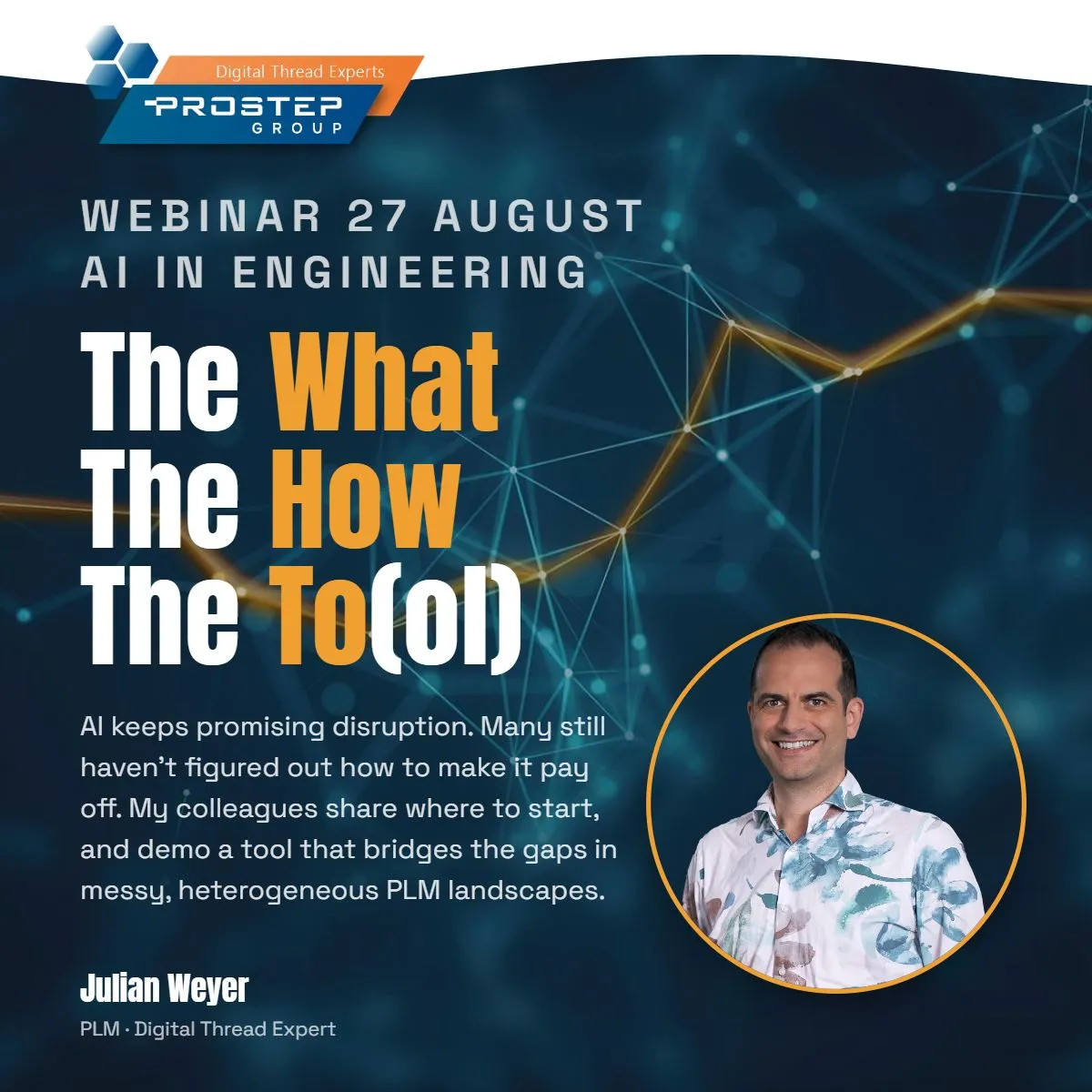
My colleagues Benny and Zacharias tackle exactly this in the live webinar on August 27:
- the WHAT — how to identify use cases with real ROI,
- the HOW — a vendor-neutral, AI-ready engineering architecture,
- and the TO(OL) — a live demo of the PROSTEP AI Workbench (PAW).
I am in fact working on such a “list” right now — but the aim is explicitly not that it has to fit every company in every situation. Rather, it should provide a catalog as a kind of inspiration for what AI can make possible.