
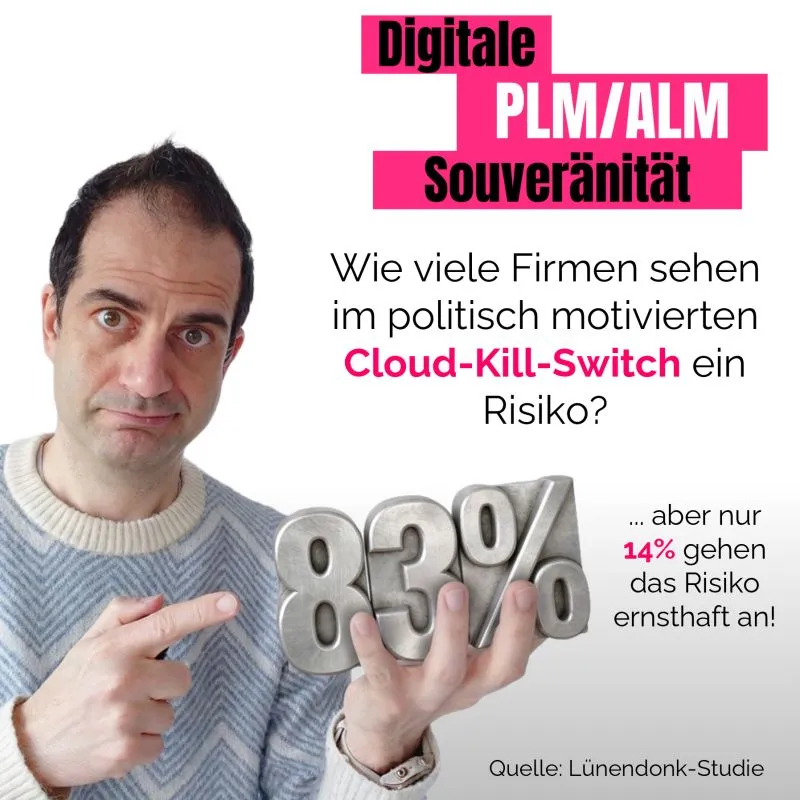

83 percent of companies fear the geopolitical cloud kill switch. 14 percent are seriously preparing for it.
I recently came across a new find online: “Digitale Souveränität – Vom Risiko zur Resilienz” (Digital sovereignty: from risk to resilience), a study by Lünendonk & Hossenfelder Marktforschung.
Two of the figures that jump out: 83% of companies see the geopolitical kill switch as a relevant risk. And 57% have an exit strategy.
57 percent? Seriously? That seems a bit optimistic to me. A look at the details of the study shows that only 14% of respondents FULLY agree that such a strategy exists, along with action plans. The other 43% have perhaps thought about it once and written a memo.
As is well known, I don’t think much of doom-mongering. And I honestly don’t believe (or hope?) that the risk of someone pressing the kill switch tomorrow is huge. But first: what is still “certain” these days? And second: risk management should consider not only the probable risks but also the improbable ones, if the impact would be fatal.
And just imagine: a German machine builder suddenly can’t reach its design data in PLM overnight. Calculations. Simulation results. Or software specs in the ALM tool. That is a threat to the company’s existence.
And an exit strategy from a cloud tool is not something you just pull out of your sleeve overnight, least of all once the damage is already done.
My appeal: work out what level of sovereignty is right for your company. Don’t be driven by doom-mongering, but become aware of the risks. And then develop a solid strategy to mitigate the sovereignty gap you’ve identified.
Source: Lünendonk & Hossenfelder – Digitale Souveränität (Thanks to the authors Mario Zillmann and Tobias Ganowski for a truly insightful study.)
83 percent see the risk, but only 14 percent have really made provisions. The real task for PLM/ALM sovereignty lies in exactly this gap between risk awareness and ability to act: not panic, but a solid exit strategy, worked out in good time.