
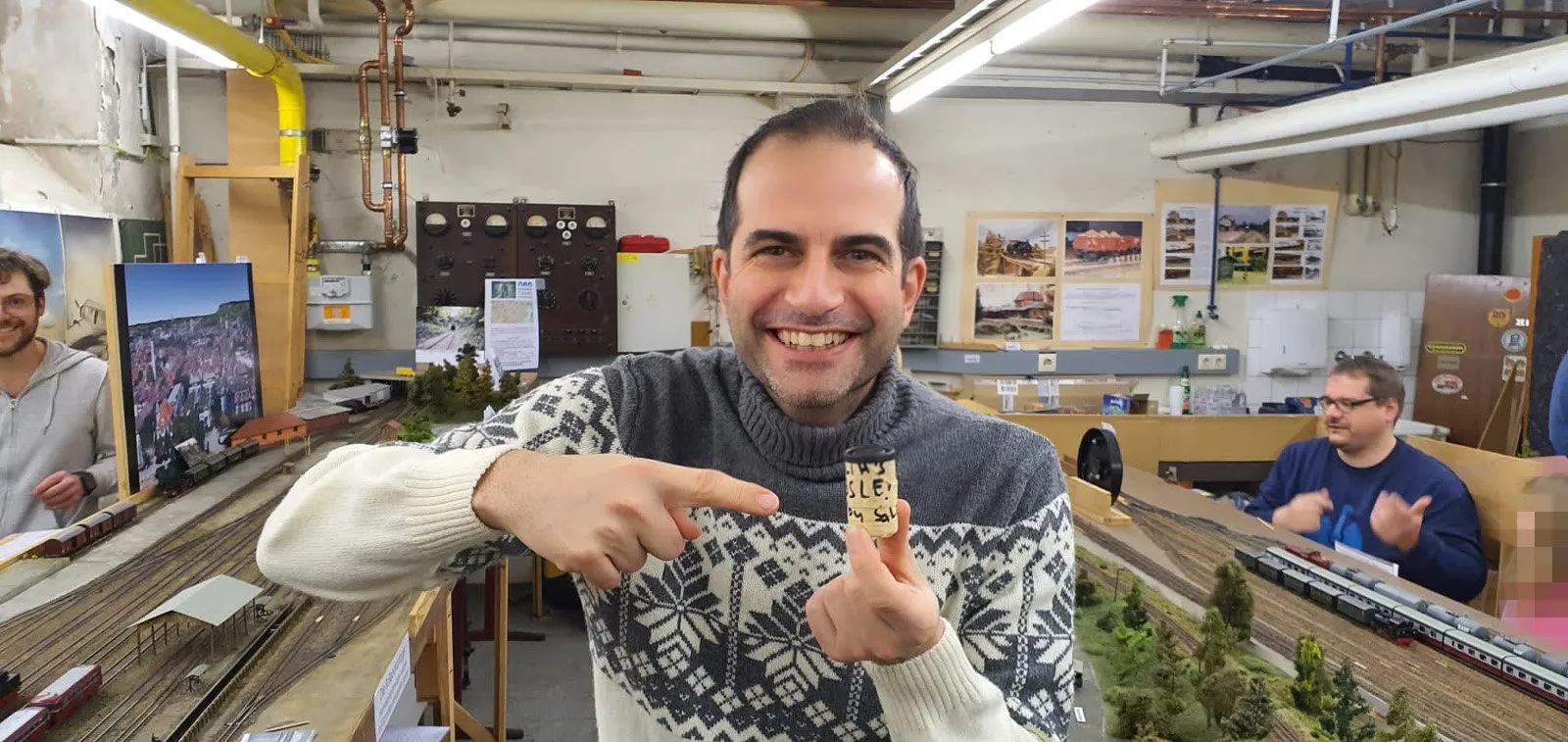

Today I went to the alumni reunion of the model railway club at my old school, the Robert-Mayer-Gymnasium in Heilbronn.
It feels like I spent my entire time at secondary school in the school basement every second (or maybe even every) Saturday, together with a few other enthusiasts and our chief engineer Helmuth (a physics and maths teacher by trade and a master of tracks and switches).
Our big project: a replica of the Bottwartalbahn as it looked in the golden 1960s. An ambitious goal that took many hours, sweat and love of detail.
It was great to see my own contributions to the layout again, such as the electromechanical control desk of Sontheim station or the electrically swiveling coal crane. In general, people say that even back then I had a certain knack for automation of every kind 🙃.
My “Dösle” was even still there, the ultimate patent-worthy (😂) helper tool (copyright by me 😉).
What is the “Dösle”?
Anyone who has ever built a model railway knows the process of “ballasting”. Fine cork (or other) granules are spread between the tracks to imitate ballast. The 7th-grader I was back then must have found spreading it with a teaspoon too tedious. So what could be more obvious than making a hole in the bottom of a film canister and getting the ballast onto the tracks with a stirring motion…
Did it work? Well… Lesson 1: people still talk about it today. Lesson 2: innovation is never a straight line. And we’ll draw a veil over all the other details 😉